History

Book Review: The Making of the Atomic Bomb

The Making of the Atomic Bomb
by Richard Rhodes
Simon & Schuster, 1986.

Five years in the writing, Richard Rhodes' history of the atomic bomb has become a landmark in the field of science popularization. At over 900 pages long, it presents a comprehensive account of the events that led to the production of the terrible weapon ever devised by man. It is really several different books in one, shifting in tone and emphasis as it follows the concept from start to finish: from scientific discovery to military-industrial project to the study of political decision-making in war.

Scientific discovery

The first third of the book is largely an account of scientific discovery, as experimenters worked to uncover the structure of the atom at the turn of the 20th century. Even in this foundational period, it was easy to see that nuclear bombardment involved energies that were orders of magnitude greater than the chemical reactions already familiar to science. It was natural to speculate about how to unlock those energies someday, and thus the dream of nuclear energy developed right alongside the earliest experiments. Frederick Soddy described the possibility of nuclear energy in his book The Interpretation of Radium (1909), based on his work alongside Ernst Rutherford. H. G. Wells then picked up on the idea in his famous novel The World Set Free (1914).

But the early nuclear bombardments could only play with atomic forces at a small scale. With the discovery of nuclear fission, it became obvious that a chain reaction was possible and could be used to multiply the energies released. But it would not be worked out in a time of peace on earth and brotherhood among men. With the expulsion of Jewish academics from German universities and the looming onset of World War II, the leading lights of atomic science left Europe for America. In just a few years, the center of gravity in the physics world had shifted across the Atlantic.

[...]

Book Review: Why England Slept

alt

Why England Slept
by John F. Kennedy
New York: Funk, July 1940.
Reprinted by Greenwood Press, 1981. ISBN 0313228744.

It is difficult to read Why England Slept without seeing the shadow of the future president hanging over every word.  Most prophetic indeed is Henry Luce's foreword, which notes on p. xiv:

In recent months there has been a certain amount of alarm concerning the "attitude" of the younger generation. If John Kennedy is characteristic of the younger generation—and I believe he is—many of us would be happy to have the destinies of this Republic handed over to his generation at once.

[...]

Film Review: Becket (1964)

Becket (1964)
directed by Peter Glenville
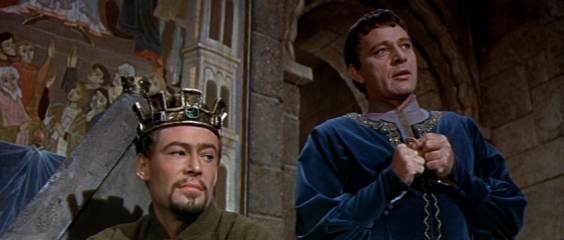
Frames in this review are taken from the MPI DVD.

Some Kings and Queens of England just make for better subjects of drama than others. George IV isn't nearly as interesting a character as George III, and Anne can't hold a candle to the various Henries. Such audacious and colorful characters they were, those Henries! There was Henry VIII, who converted England to Protestantism for purely selfish reasons, and ended up changing the course of history. There was Henry V, as forever immortalized by Shakespeare [link to film review], who established the English claim on the French throne and brought back a French bride from his continental wars.

But it is an even earlier Henry who features in Becket, only the second King of England to carry the name. Although the credits award first billing to Richard Burton in the title role of Becket, the film is as much about Henry as it is about Thomas à Becket. Becket is straightforward and uncomplicated — at first a worldly and scheming advisor to the King, he later becomes resolute in his godliness after becoming Archbishop of Canterbury.

[...]

Book review: 1421


1421: The Year China Discovered America
by Gavin Menzies
Hardcover, US edition: New York: Morrow, 2003. ISBN 0-06-053763-9
Trade paperback, US edition, revised: New York: Perennial, 2004. ISBN 0-06-054094-X

[...]

Menzies, a retired Royal Navy submarine captain, claims that four separate Chinese fleets under the overall aegis of the great eunuch admiral Zheng He sailed on great voyages of discovery about the year 1421.  During these voyages, they discovered the Americas, Antarctica, Oceania, various Pacific islands, and longitude — basically, every continent except Europe.  The Zhu Di emperor's death, however, put an end to the great voyages of discovery.  China turned her energies inwards, and records of the Zheng He voyages were destroyed.  Within a century, though, Europeans picked up the mantle of discovery. These great explorers thus bravely set forth into the (not-quite) unknown, ultimately handing Europe the mantle of world dominance on the back of Chinese maps.

[...]

Syndicate content