Film Review: Becket (1964)
Becket (1964)
directed by Peter Glenville
Frames in this review are taken from the MPI DVD.
Some Kings and Queens of England just make for better subjects of drama than others. George IV isn't nearly as interesting a character as George III, and Anne can't hold a candle to the various Henries. Such audacious and colorful characters they were, those Henries! There was Henry VIII, who converted England to Protestantism for purely selfish reasons, and ended up changing the course of history. There was Henry V, as forever immortalized by Shakespeare [link to film review], who established the English claim on the French throne and brought back a French bride from his continental wars.
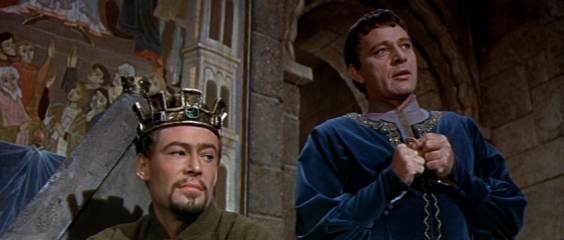
But it is an even earlier Henry who features in Becket, only the second King of England to carry the name. Although the credits award first billing to Richard Burton in the title role of Becket, the film is as much about Henry as it is about Thomas à Becket. Becket is straightforward and uncomplicated — at first a worldly and scheming advisor to the King, he later becomes resolute in his godliness after becoming Archbishop of Canterbury.
Becket serves as a foil to Henry in their numerous exchanges, and never strays far from the king's mind. But the reverse is not true. Though Becket is troubled by his clashes with his royal friend, there is room only for one mother in his heart. Once he has chosen Rome over England, he experienced no soul-searching bouts of indecision, no questions of turning back. While the film's events are driven by Becket's actions, the plot isn't actually about Becket, but rather about Becket's impact on Henry. Indeed, we would not remember the name Becket today had he not clashed with the king.
Plot and History
As with the most delicious historical dramas, Becket takes many liberties with the facts. French playwright Jean Anouilh introduces racial and class strife into the picture by having Becket come from among the Saxons of England, oppressed by the rule of the imported Norman nobility. But the plot generally follows the broad brushstrokes of history. Henry confers the Chancellorship of England upon his good friend Thomas Becket and goes off to fight Louis VII over some land in Northern France. To fight this war, he has requisitioned soldiers and money from his subjects. However, the Catholic Church of England refuses to contribute, being ever mindful of its wealth and privileges.
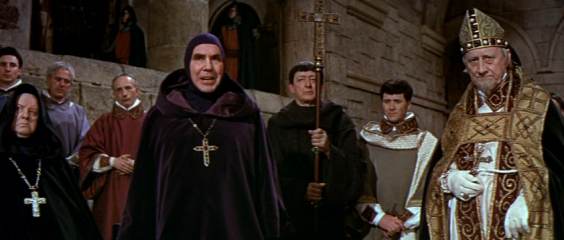
In a great stroke of luck, the Archbishop of Canterbury dies, and Henry has the bright idea to install Becket in his place. With his right-hand man heading the Church, he feels certain of finally having checkmated the pesky clergy and ensured their subservience. But once installed in a spiritual position, Becket discovers a newfound purpose and becomes a staunch champion of Church prerogatives. When a clergyman is accused of a crime, Becket insists that only an ecclesiastical court can try him. When one of Henry's nobles orders the man’s execution after an escape attempt, Becket excommunicates the precipitous Lord Gilbert.
An infuriated Henry then tries to strip Becket of his position, serving trumped-up charges of embezzlement during his term as Chancellor. Fleeing England, Becket first finds refuge with Louis VII, then proceeds to Rome to seek Pope Alexander III's interdiction. The Pope warns him to tread carefully, and Becket retreats to a monastery. Finally, Becket reconciles with Henry in a dramatic meeting on the beach, as Henry's and Louis' entourages observe for posterity.
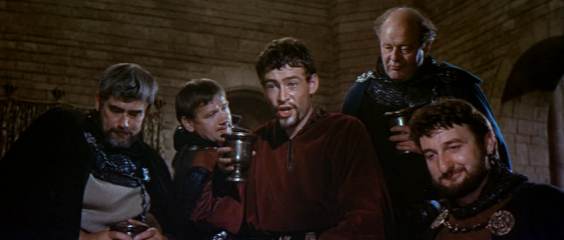
But this reconciliation doesn't last long. Henry takes a stab at Canterbury by decreeing that his son Henry would be crowned in his lifetime at the rival cathedral of York. Afterwards, drinking himself into a stupor with his uneducated nobles at his side, Henry issues the apocryphal line, "Who will rid me of this meddlesome priest?" The nobles take him literally at his word and slay Becket in the cathedral as he prepares for vespers. But it is Becket who has the last word, for he is declared a saint, and Henry submits himself to the lash as penance for causing Becket’s untimely death. The film is framed as a flashback, as Henry kneels in front of Becket's effigy and talks to his late friend.
Characters
But the story only scratches the surface. The film, translated from the French play, is a cornucopia of clever exchanges and incisive wit. At one point, Henry gives Becket his ring with three lions on it, and tells him: "There, that's the Great Seal of England; don't lose it. Without the seal, there's no more England, and we'll all have to pack up and go back to Normandy." But there are also searching questions about destiny and friendship, and verbal clashes that produce enough conflicts to supply an entire college class with individual essay topics. Norman vs. Saxon, cultural refinement vs. coarseness, intelligence vs. vapidity, family ties vs. scheming, war vs. peace, France vs. England, the Church vs. the State, all of these intertwined with the most central conflict of them all: Henry vs. Becket.
Henry is played with relish by Peter O'Toole, who became so iconic in the
role that he later played an older, more considered Henry II opposite
Katharine Hepburn's Eleanor in
The Lion in Winter
Becket the Saxon is suave and refined compared to the boorish Norman nobles, and may very well be the smartest person in England. "Always thinking," says Henry of his best friend, "He's read books, you know." Beneath Richard Burton's smoothly paced lines is an unmistakable shrewdness backed by careful consideration. It is this resourcefulness that leads him to bribe a French town to throw open its gates, rather than have to take it by force and pillage. The town showers Henry with a hero's welcome as he enters the city gates, but Becket only bought the poor, for the rich cost too much.
Becket has little need to yell until he runs around charging Henry's officers with eternal damnation of their souls. He almost longingly refers to Henry with a softly-spoken "my prince" even while the king is growing ever more pained and infuriated by their confrontation. He is initially unconcerned with honor; he serves the king, and is practically Norman in all but blood (and table manners). But he has an essential kindness about him even before his spiritual enlightenment, saving a poor peasant girl from being ravished by Henry by asking to have her for himself (when he has no intention of doing anything to her). It is this quest for meaning in his life that makes Becket put his stake in the ground when his moment in history arrives.
Yet Henry is a capable ruler in his own right. He is well-versed in playing competing interests off against each other, and he is the one manipulating Becket for his own purposes by installing him in various offices. Thus Becket's change of heart is especially wounding to Henry, as he is then left with no one else in the world to call friend. Henry has strained relations with his mother, the Empress Mathilda (a severe Martita Hunt), who ignored him as a child. He hates his own children and shuns his wife Eleanor (Pamela Brown) as a dry desert, with whom his procreative duty was nigh-unbearable. There is no hint of love in Henry, for Anouilh's Eleanor is not the conniving love-her-and-hate-her Queen of James Goldman's play. She is rather aloof, somewhat of a nag, and seemingly doomed to fight Henry without much success. At one point, she is so stunned by Henry's outburst that she has no rejoinder than to run away crying, feebly threatening to complain to her uncle the Emperor.
In this lack of love, Becket is no different at first. The captured Welsh noblewoman Gwendolen (archly elegant Siân Phillips, speaking with an accent that adds a touch of mystery to the role) is very much in love with Becket, a companion from a race conquered by the English. But though he spends much time with her and clearly enjoys her company, he does not return the sentiment. As Becket the Chancellor points out to the clergymen in their opening confrontation with Henry, his mother is England. He cannot even deny Henry when the King claims Gwendolyn for himself, nor can his cold heart take her back when the king is done with her. In an poignant and sad moment, Gwendolen bids him farewell by giving him her harp, saying as her voice begins to break up, "You've almost learned to play it." What eloquent dialog.
Driftless people make some of the most devoted converts to religion. Is it any surprise then that Becket finds a purpose in life when he learns to love holy mother Church? This is why Becket can withstand the upcoming conflict with assurance and confidence, while Henry's moves are constantly undermined, leading the King to exclaim in exasperation, "Are there no men in England?" Becket can put his trust in God to set him on the proper path for carrying out His mission. And yet, it is Henry who has the freedom initiate action.
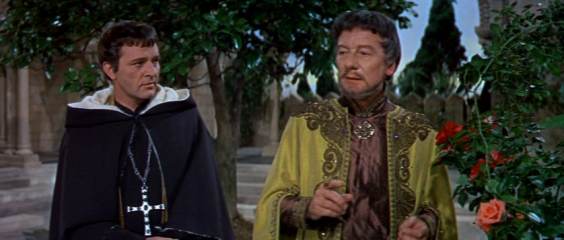
In contrast, Becket is but a puppet, first manipulated by Henry, then by Bishop Folliot of London (Donald Wolfit, intense, but with a reservoir of cunning underneath). It is the Bishop of London who first incites Becket to defend the independence of the ecclesiastical courts, as he would have done had he become Archbishop. Even when Becket escapes across the English Channel with his fiery young Saxon assistant Brother John (David Weston, alternating fury with sullenness), he is used by King Louis and Pope Alexander. A cultured King Louis (played by John Gielgud with a twinkle in his eye) tells Becket as much amid the fresh air and bright light of his palace. Had he been faced with a similarly troublesome clergyman, Louis would've done exactly as Henry had done. He is granting Becket his protection for the sole reason that it will trouble the English throne.
In this way, the play can be said to lean towards the secular position in the nominally central dispute. Just as Henry's illusions about the cheering throngs in the captured town are quickly dispelled by Becket's explanation of the arrangements, so too are the old Archbishop of Canterbury's platitudes about being "men of God" swiftly punctured by Henry's observation that monks fought fiercely during the Conquest, when there was pillage to be had. The Pope backs Becket only tentatively, mindful of the political game to be played, and the ambitious Bishop of London eagerly leaps to Henry's side when the trumped-up charges of embezzlement are dangled before his eyes as a means of obtaining the desired archbishopric.
Though Becket is as fearless as Martin Luther would later be, he fights ultimately for a losing cause, subtly tarnished by the fact that we never determine the guilt of the offending clergyman who caused the hubbub. Today we take it for granted that civil authority must trump ecclesiastical law. As for the independence of the Church from state authorities, that will be swiftly dispatched with in England, six Henries down the road.
Thus, although spiritual matters provide the impetus for the plot, the play focuses on Henry and Becket. Becket is never far from Henry, even when separated by hundreds of miles. As Becket is heading toward immortality, Henry is living with the family that he dislikes and drinking with the brain-dead Norman nobility. (One of them replies to Henry's inquiry with the proud claim that he "never" does any thinking that doesn't have to).
There is fatalist streak in Becket, as he calmly orders the doors opened for vespers even as armed men are waiting outside. But ultimately, one must wonder who gets the upper hand. Henry is stripped and whipped after making his peace with Becket, but there is a bit of nonchalance in his manner as he loudly proclaims that the murderers must be punished, then tells those very same nobles that everyone must make their peace with Becket. Even in his soliloquy in front of Becket's tomb, there is the hint of uncertainty and possible insincerity with qualifiers like "I suppose." Becket is canonized and Henry has been taken down a notch, but he has now regained the love of his people and no Becket to trouble him any longer. Is this true contrition, or just a show?
Conclusions
For fans of dialog and plot, you could probably slap the flimsiest of
film conventions on Anouilh's play and still end up with a fine film.
But the filmed Becket, directed by Peter Glenville, is no
hastily "opened-up" stage play. Edward Anhalt's Academy Award-winning
screenplay cannot completely disguise its stage origins, with long scenes
of characters making long speeches and snapping fast exchanges to each
other. But it inserts enough establishing shots and changes of scene to
provide the other technical arts with the opportunity to make a truly
cinematic film. After all, the film was nominated for Oscars in eleven
other categories, although none of them stood a chance against
My Fair Lady
The costumes and art direction place us firmly in the dark world of medieval English castles. The French palace and other French locations, in contrast, are light and airy, with finely-dressed people and rich furnishings. It is clear which is the more civilized nation at the time. John Cox's sound is clean and unobtrusive, and Laurence Rosenthal's score adds color with its heraldry and underlying soft emotion, while having the good sense to go away altogether when the viewer concentrates on the twists and turns of dialog.
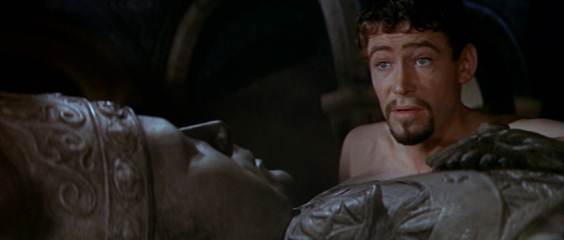
Geoffrey Unsworth's cinematography and Anne V. Coates' editing are particularly effective and delightful to observe. While the intense drama overshadows many of the other technical aspects of the film, talking heads might call unwanted attention to the artificiality of the play format, were it not for the filmic arts that add visual interest to the screen. Unsworth's lighting brings out the detail in the interiors even while maintaining an appropriately dark feel overall. Camera motion is smooth and well-coordinated, with meticulous blocking of the actors for very structured compositions. The camera moves from one perfectly-composed shot to another, with complicated dollies and pans and tilts to transition among them.
Unsworth plays with spatial relationships, sometimes using split diopters to maintain focus on two far-apart focal planes in a dimly-lit room. There is a surprisingly intimate two-shot of Henry talking to Becket's effigy in the cathedral crypt, which matched with a similar two-shot during the flashback section, but with the sizes reversed so that Henry is now much larger than Becket. Who's pulling the other's ropes? The photographic statement on spaces well complements Peter Glenville's direction, which has Henry pacing around impatiently, generally staying far away from everyone except Becket. Coates, as usual, makes the difficult task of seamless editing look effortless. Not once does the viewer have a desire to see any angle other than the one being presented. Editors cut by instinct, but somehow her instinct becomes our instinct as soon as it hits the screen. A wordy 148-minute film goes by so quickly that the viewer is left pining for the sharp wit of those 12th-century characters as soon as the film has ended.
As with many other independent productions over the years, Becket's original negative was neglected, and a restoration was only completed in 2003 by the Academy Film Archive. Further rights issues held up its DVD release until 2007, when a limited theatrical re-release was also done. [link to article explaining the situation] The DVD is not great, but it's acceptable, and certainly beats the bare-bones MGM DVD of The Lion in Winter, the other great 1960s historical drama starring Peter O'Toole as Henry II.