Film Review: Those Magnificent Men in their Flying Machines (1965)
Those Magnificent Men in Their Flying Machines
or: How I Flew from London to Paris in 25 hours 11 minutes
(1965)
directed by Ken Annakin
Frames in this review are taken from the Fox DVD, which shows once again
that price is entirely unrelated to technical quality.
Those Magnificent Men in their Flying Machines is surprisingly
funny for a comedy from 1965 filmed in 70mm. Too often, such films can’t
quite decide if they want to be comedies or epics, as the immensity of
the large-format photography detracts from the snap-and-crackle necessary
for good comedy. The cult favorite
It's a Mad, Mad, Mad, Mad World
Magnificent Men does not suffer from these problems. Although every character is a stereotype, the acting remains fairly natural and nobody feels like he has to ham it up. The film also does a good job with special effects. Process shots are infrequent, as most of the flying was done in real life with actual reconstructions of period machines. What process shots do exist are done with substantial care and show only mild artifacts. Much of the film takes place outdoors, while indoor sets are spacious and dressed in great detail to take advantage of the large-format photography. It’s a handsome production that actually manages to produce a fairly good 70mm comedy.
Stock characters
The story revolves around a 1910 London-Paris air race sponsored by the Daily Post. Its patriotic editor Lord Rawnsley (Robert Morley) offers a prize of £10000, expecting, of course, that Britannia shall rule the air and defeat all challengers. His daughter Patricia's (Sarah Miles) suitor, an earnest young Army officer named Richard Mays (James Fox), flies on weekends and is Britain’s great hope. His rival, in the race as well as in her affections, is the down-to-earth American Orvil Newton (Stuart Whitman), who is so broke that he wouldn't be able to ship his plane back home if he loses the race.
And, of course, there are participants from non-English speaking countries as well, each representing the appropriate British stereotype about his country of origin. Italian aviation pioneer Count Emilio Ponticelli (Alberto Sordi) is a good Catholic, with half a dozen children and a warm heart. The German Manfred von Holstein (Gert Fröbe) is a pompous colonel in the army, and his French nemesis is the mischievous paramour Pierre Dubois (Jean-Pierre Cassel). The Japanese Yamamoto (Yujiro Ishihara) becomes the odds-on favorite to win when he arrives after a long journey on the Trans-Siberian Railroad. In opposition to these staunch pioneers is the dastardly British scoundrel Sir Percy Ware-Armitage (Terry-Thomas), the onscreen saboteur who can be found in nearly every race film.
The stereotypes are fairly light-hearted except for the Germans, who parade around to tiresome martial music issued entirely from Colonel von Holstein's vocal cords, complete with drums, cymbals, and brass. But their military nature gives them an advantage over the French — Dubois tries to make fun of the Germans by organizing a French flag ceremony to the tune of Frère Jacques, but his mechanics stumble all over each other and the flag falls off the staff. Just before the race begins the French finally get a phonograph record of La Marseillaise and manage to get their flag all the way up to the top. And those spiked German pickelhaube helmets are put to good use puncturing balloons ...
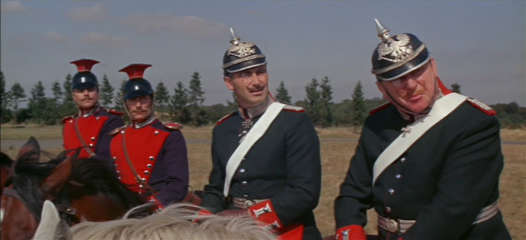
The slapstick comedy isn't the highlight of the film. The German plane gets loose and chases a fire truck around a field, and a sped-up chase sequence ensues. Patterned after silent comedies, it is not at all inventive and quickly becomes repetitive. On the other hand, the mechanical comedy works better — although many planes crash in the film, they break down in quite varied ways. Some of the mechanical contraptions are truly outlandish, one with wings flapping like a bird.
The wry verbal humor works better. The two most important capitals of the world are, of course, London and Paris. Tossing a dozen letters into international mail bins: "You know, between these invitations and the newspapers, we should reach every flying man in the world." And the pervasive joke about the limited capabilities of the planes — Flying across the English channel? How daring, it's twenty-two miles of open water! There's also the girl that Dubois keeps seeing, but she's always a different nationality each time and named after a famous actress: Brigitte, Ingrid, Marlene, Françoise, Yvette, or Betty.
The character conflicts come from the stock of tried-and-true movie moments. But the love story does better. The peculiarly reserved British courtship, mixed with Patricia's tomboyishness and mechanical aptitude, is the best part of the film. Richard and Patricia are clearly going to end up married, but Richard is reluctant to take her up into the air due to her father's opposition. There's a marvelous contrast between the impish Patricia, with her wide smile and pleading eyes, and Richard, carrying a strained composure and finding excuses not to take her up (Oh, and by the way, please don't kiss me, I'm on duty). But he clearly fancies her, allows her to help him with the plane, keeps her motorcycle riding secret from her father ("Exciting, isn't it?"), and offers to let her drive the car. As the suave young Englishman with a public school accent, James Fox is first-class.
Patricia is bright and free in the opening shot riding a motorcycle, and
Sarah Miles acts the part with charm and energy. But she soon has to
give up her trousers and put on a Edwardian dress. Thus confined to a
ladylike garment, Miles is more restrained, not just physically but also
in her acting. It would’ve been a lot more fun to have her put on
trousers and sneak around behind her father's back. She finally gets
around her father's wishes by flying with Orvil, who’s used to
barnstorming around with women in the American West. But Patricia's
relationship with Orvil seemed rather forced, and not just because of the
Texas accent and cowboy manner. 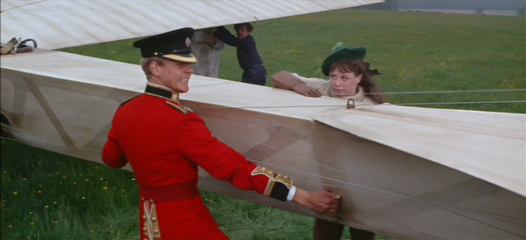 Director Ken Annakin explains on the DVD commentary
that Stuart Whitman fell for Sarah Miles in the course of filming,
pursuing her off the set as well as on. Subsequently, it became
difficult to get Miles to do romantic scenes together with Whitman. The
redeeming feature of the American fling is the jealousy it inspires in
Richard, which is rather fun to watch and underscores their easygoing
banter.
Director Ken Annakin explains on the DVD commentary
that Stuart Whitman fell for Sarah Miles in the course of filming,
pursuing her off the set as well as on. Subsequently, it became
difficult to get Miles to do romantic scenes together with Whitman. The
redeeming feature of the American fling is the jealousy it inspires in
Richard, which is rather fun to watch and underscores their easygoing
banter.
And, of course, every good British comedy must make fun of the British class system. Lord Rawnsley has a prospective father-in-law's chat with Richard — and his approval may be taken for granted, for, after all, he went to school with Richard's father. But Richard is a busy young army officer, what with all the plane-flying and dinners and socials and card-playing with fellow army officers — there just aren't enough days of the week for marriage. Later on, Richard has engine trouble during the race and swoops over an aged couple for a landing on an open parkway. The man refers to his wife as "the memsahib" and hasn't even heard of the Daily Post air race — because he reads The Times.
Technical
The film looks marvelous. The film still looks clean as a whistle, with very little dust apart from the process shots. They're definitely there, but you won’t see them unless you’re looking for them. Probably transferred directly off 65mm preservation materials, too. Fox struck a fresh 70mm print in 2003, which suggests that the source material is in fine condition.
Colors in the daytime are especially vibrant, with the multihued costumes catching the eye in all their splendor. Colors at night still suffer a bit from the decades-old stock, a bit of magenta shift in the shadows, but nothing obtrusive. Your eyes are too busy looking around the room, admiring the detail. The vibrant colors draw attention to artifacts from the era: a Mercator world map dotted by colors for the colonial powers, the old red-white-and-black flag of the German Empire, the coat-of-arms on the Italian tricolor, the 46-star United States flag. And wow, does that red-coated British uniform pop out of the screen.
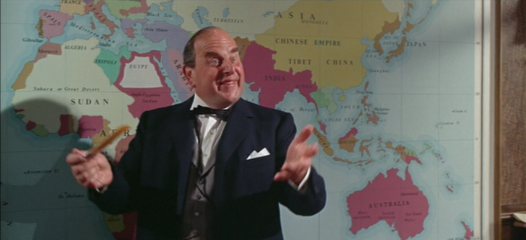
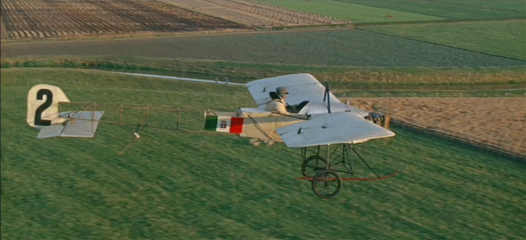
The interesting thing about the visual effects shots is how well they were done, considering the era. There doesn’t appear to be much bluescreen, and what little bluescreen there is in the film is done well. The 5.1 remix is extremely clear, noiseless, and subtle — listen for that faint music track playing behind the quieter scenes. The sound recording is best in the roar of aircraft engines, while the sound effects are merely annoying in the few cases when they are used for slapstick effects — they’re simply too out-of-place. Apart from the diegetic music of Frère Jacques, Ron Goodwin's score borrows heavily from recognizable pieces like the German anthem and Rule Britannia, though the title song is fairly catchy and sticks with you a while after viewing.
Magnificent Men looks and sounds spectacular when projected on a LARGE screen with a wide speaker spread. And for all its shortcomings as a comedy that doesn't quite make the most of a promising premise, it does the 70mm Todd-AO spectacle bit very well. A medium close-up is about as close as it gets, and there's always a lot for the viewer to look at in the background. Your eyes really wander around on those wide-open shots, picking out spectators, trying to read signs in the distance. With the compositions and breathtaking aerial visuals, it's really quite the visual experience. And of course, that 20th Century Fox Fanfare is ideally suited for proscenium openings like the one on Magnificent Men.
Oh, and the editing is seamless. I didn't realize that Anne Coates was one of the editors until I saw her name in the credits. It works so well on a subconscious level that it's unnoticeable, enhancing the plot and the scenery and engrossing the viewer.