Film Review: Pillow Talk (1959)
Pillow Talk (1959)
directed by Michael Gordon
starring Rock Hudson, Doris Day, Tony Randall, and Thelma Ritter
Whenever a remake comes out, you can count on the original film being
placed on the DVD release schedule. And even though the deliberately
retro
Down with Love
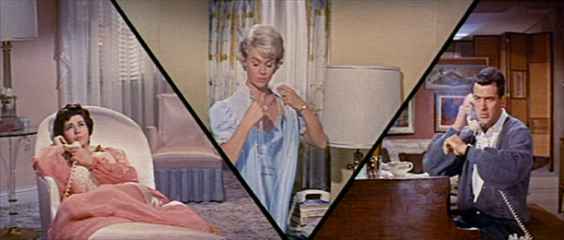
Those phone conversations launch the plot, as the premise for the comedy is that songwriter and playboy Brad Allen (Rock Hudson) shares a party line with interior decorator Jan Morrow (Doris Day). He's constantly hogging the line, crooning the same old love song to different women in English and French. Doris Day kept playing pure virginal characters, and romance isn’t on her character’s mind this time either. She’s happily single and resisting advances from her clients, but she is quite annoyed that she never gets to use the phone line. When the two parties get on the line simultaneously, Allen attributes her party-crashing phone interruptions to her "bedroom problems." She then happily redecorates her bedroom.
When they finally meet in person, however, Allen is surprised at how pleasant and attractive Jan Morrow is. To leave his phone persona behind, he adopts a fake Texas drawl with an equally-stereotypical name of Rex Stetson. He then behaves as the perfect gentleman when he’s with her, and then makes further inroads by using his phone persona to warn her away from this obviously-fake Texas rancher. It's working, except for one connection. That client of Jan's is a college buddy of Allen's. After the secret gets out, how will Brad and Jan reconcile and get married?
Humor in the details
This love-hate relationship is the opposite of the one in
The Shop Around the Corner

The humor is in the details, and Pillow Talk fairly crackles with wit. The script is loaded with double-entendres, some that are fairly risqué even for today. It must’ve been a real hoot getting it past the Code censors. On the other hand, the Code was only a more conservative version of today's wink-and-a-nod ratings rigmarole. The studios knew how to get a picture through if they really wanted to skirt the rules.
Pillow Talk is loaded with in-jokes that play on a certain knowledge about the culture of the period. Some of the in-jokes play with the actors' best-known roles. For example, Rock Hudson played a Texan much more seriously in the dramatic Academy Award-winning epic Giant. And Doris Day never gets to go through a film without singing some fabulous songs, even though this time he’s supposed to be the songwriter!
Others jokes play on the cosmopolitan nature of the City and the suburban-housewife role of 1950s America. From the stereotypically grand music as the camera tilts up a skyscraper, to characters getting romantic advice from their psychiatrists, to the overeager Harvard man who "dig[s] older women," Pillow Talk takes jabs at the things that everybody knew about but nobody talked about in polite society. Notice also that all the nightclubs patrons are lily white, while the musicians are all black or Caribbean. There seems to be some hidden social commentary here, because there are plenty of movies with nightclub scenes featuring white performers.
Still other in-jokes must've been either unintentional or truly limited
to the inner circle. For example, Allen toys with Jan on the phone by
suggesting that her Texas gentleman Stetson is gay. When they next meet
in person, Rock Hudson dangles his pinky and discusses recipes until Jan
practically begs him to kiss her to prove it isn't true. I’m surprised
this made it into the film at all, considering that the very next year,
Stanley' Kubrick’s sword-and-sandals epic
Spartacus
The uncertainty at whether they're poking fun at the obvious or the not-so-obvious, as well as the feeling of "How did they get away with it in 1959?" give Pillow Talk an added dimension. And unlike Down with Love, this film not at all self-conscious, so we accept the style at face value. Indeed, the his-and-her split-screen aesthetic is quite creative, as in the bathtub scene.
If you’re just in the mood for just some laughter to brighten up a dreary day, Pillow Talk also works on that level. Doris Day is as bubbly as chewing gum, Rock Hudson is delightfully chauvinistic, and Tony Randall puts in his usual insecure sidekick appearance as Jan Morrow’s client and Brad Allen’s college buddy Jonathan Forbes. Jan's alcoholic maid is played by Thelma Ritter in much the same role that she played in Hitchcock's Rear Window — the dour, wisecracking working-class woman who thinks that the two principal characters’ battle of wits is silly and they should just jump into bed.