Film Review: One in a Million (1936)
One in a Million (1936)
directed by Sidney Lanfield
Frames in this review are taken from the VHS tape released by Fox Video
in 1993.
When you see a Hollywood studio film from the Golden Era, you know pretty much what you'll get. However much the plot may twist and turns, Judy and Mickey will put on a show, Fred and Ginger will dance round and round, and Esther Williams will find a way to get wet. If the film happened to come from Twentieth Century-Fox and star Sonja Henie, then you’ll be sure to see a skating exhibition. The Norwegian figure skater Henie was one of the first to cash in on her athletic prowess on a grand scale, and is often regarded as the prototype for Olympians on cereal boxes.
One in a Million is the first of the Fox skating pictures. It was produced in 1936, shortly after Henie won her third Olympic gold medal and turned professional. Henie plays (what else?) an amateur skater named Greta Muller, living in Switzerland with her innkeeper father Heinrich (Jean Hersholt). Heinrich knows a little bit about skating himself, having won gold at the 1908 Winter Olympics and had the medal taken away from him due to accusations of professionalism. In a Hollywood film, of course, the good guy can’t possibly be guilty of those charges. Ever since, Heinrich Muller has been cultivating his talented daughter, dreaming of recapturing that medal.

But that's not enough plot to fill a 94-minute movie, so we get to bring in a bunch of Americans. First, there's Thaddeus Spencer (Adolphe Menjou), a down-on-his luck bandleader touring Europe on a shoestring budget with his wisecracking wife Billie (Arline Judge) and girl band. They're so unlucky that their hotel burns down just before they arrive, leaving them freezing under their overcoats with their summer costumes on. But not to worry, Muller's inn is just down the street. And there happens to be just enough rooms to accommodate them and the other characters that show up in the film.
Two of these characters are Bob Harris (Don Ameche), a reporter for the Paris Herald, and his grumpy photographer Danny Simpson (Ned Sparks). Danny isn't too impressed by the innkeeper's daughter, but Bob is smitten and spends the rest of the film talking to her in soft tones with a big smile on his face. While Danny tails Ratoffsky (Montagu Love), a cultured guest at the inn who's been behaving in a rather hush-hush manner, Bob pursues Greta and tells his editor about the great human interest story he bumped across.
But bandleader Spencer is dazzled while watching Greta skate on ice at the local pond, and dreaming of "A hundred Fred Astaires! A hundred Pavlovas on ice!" he takes her along on an exhibition tryout for a prospective engagement. Bob arrives after Greta has skated one number, warning that the fact that Spencer got paid for the show could jeopardize her amateur eligibility for the Olympics. What will happen, especially with an honor-bound father who would rather his daughter be disqualified than have her medal taken away later, as happened to his medal?
Light Comedy
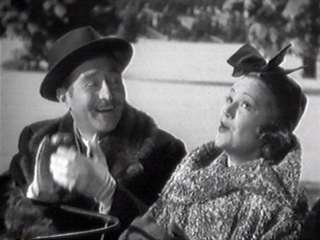
The film is one of those light comedies where nothing can really go wrong, so the outcome is never in doubt. Will she win the Olympic championship? Of course she will. Her own father has pronounced her the best figure skater in the world. And Bob has also used his indubitable expertise to tell her, "Why, you can't help winning." And besides, Spencer is counting on her victory so he'd have a star for his show. There’s even a tabulation error by the judges, which is quickly remedied. After the tricolor is raised to the strains of the Marseillaise, the announcer declares that Switzerland actually won. And when the medal is placed in jeopardy due to the charges of professionalism, why, the whole gang can just barge into the Olympic Secretary's office to explain the mistake. (You'll never guess who the Olympic Secretary is, being a cultured British knight). All of these plot twists are accompanied by fast dialog typical of screwball comedies, liberally dosed with the lingo of the day: "Gee," "Say," "Well," and "Why."
Plus, if you're competing with MGM for the box office dollars of Depression-era America, you've got to load your film with music. We have the girl band, whose instruments become fewer in number every day, singing forgettable tunes on sleigh rides. Borrah Minevitch's Rascals make an appearance playing their harmonicas. Borrah Minevitch himself joins the gang early on as Adolphe, a German who misinterprets Spencer's pleas to "Shut up" as the name of a song. The three Ritz Brothers add in a dash of madcap comedy, performing a scene on ice as movie monsters Peter Lorre (M), Charles Laughton (Mutiny on the Bounty), and Boris Karloff (any of the Frankensteins).

Add in Sonja Henie's skating routines, and you end up with a screwball comedy, a madcap comedy, a mild musical, and a dance spectacular all in one film. And while they're all done respectably well, the film never feels very cohesive. It's as though Fox, which didn’t have a Marx Brothers, a Busby Berkeley, or a Howard Hawks, simply threw in the kitchen sink so their skating film could have a little bit of everything. Well, that's why the studio system was a film-making factory.
Figure Skating!
But all that is just filler. What we’re waiting for are the skating numbers. While the art direction, choreography, and camera moves lack the polish and imagination of an MGM musical spectacular, it's exhilarating and informative to watch Henie at ease in her element. The viewer should keep in mind that 1936 is quite early in the sport of figure skating. Indeed, Henie herself invented much of the modern figure skating aesthetic with carefully choreographed dance moves and shorter, less restrictive skirts.
So don't expect a program filled with double jumps, or even dream of the triples and quadruples of today. (Speaking of jumps: the 1908 Olympic men’s figure skating event, won by Heinrich Muller in the film, was in real life won by Ulrich Salchow.) There will be a lot of skating around. But Henie does it very precisely and with an undeniable exuberance that is clearly exhibited in the routines, which were designed around a movie camera. Compare her skating with that of the French skater at the Olympics depicted in this film, and you will understand realize why Henie dominated the field in international competition for over a decade.

The burning down of the hotel? Forgotten amidst the singing and skating. The possible assassination of the premier who was scheduled to stay there? Well, as one the characters said, what's one more premier around these parts? And the charges of professionalism that threaten her gold medal? That wouldn't make for a happy ending. Can anything interrupt the gang's triumphant ice revue in Madison Square Garden, complete with a bullfight on ice acted out by the Ritz Brothers? Well, they do try to book Transatlantic passage on the zeppelin Hindenburg, but the film was released in 1936 so there’s nothing threatening about it. That year, the Hindenburg had just entered service, and it provided a faster and more glamorous alternative to the steamship lines.
And so, like Lassie coming home, Sonia Henie as Greta Muller reaps the rewards of her Olympic victory in front of a rapturous American audience.
Fox released all its Henie skating pictures on VHS in the 1990s. Apparently they didn't do so well on their first go-around on home video, for they have not been made available on DVD. In chronological order, they are: