Film Review: Easter Parade (1948)
Easter Parade (1948)
directed by Charles Walters
songs by Irving Berlin
starring Judy Garland and Fred Astaire
Frames in this review are taken from the Warner Brothers DVD.
Easter Parade was finally released on DVD in time for Easter 2005. Of course they did it for the marketing tie-in, but the film’s Easter theme is merely incidental. It’s one of those happy musicals churned out by the MGM Dream Factory, and it’s appropriate year-round. Particularly notable is the fact that this was the only musical in which Judy Garland starred alongside Fred Astaire. (Notice who goes first in the billing. Fred may have been the better dancer by far, but Judy was the bigger box office draw.)
Plot
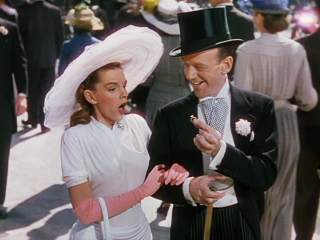
The film begins as entertainer Don Hewes (Fred Astaire) is shopping for Easter presents for his dancing partner Nadine Hale (Ann Miller). The day is bright and sunny, and the people on the streets are all smiling and greeting each other. Except Don gets home to find that Nadine is leaving the partnership. She wants to star in her own performance, and she won't be persuaded otherwise even when Don hints that he thinks of their partnership as more than just business.
The scene is interrupted by the rich young hanger-only Jonathan Harrow III (Peter Lawford), who takes Don out to a bar to drown his sorrows. There's a show going on, and Don boasts to Johnny that he could dance with any one of the dancing girls in the show. So he picks out young, inexperienced Hannah Brown (Judy Garland) from the lineup. The next morning, he has cause to regret the decision. Initial performances of their show "Juanita and Hewes" are disastrous, as she proves to have two left feet (probably because she can’t tell left from right).
Meanwhile, Johnny is off doing the MGM sidekick thing, contriving situations to get Don and Nadine back together. But wouldn’t you know, Don discovers that Hannah is really quite talented when she's left to be herself. "Hannah and Hewes" steadily improves until the two of them are auditioning for Ziegfeld himself. But Nadine is also performing there, and Don appears to be falling for her again. Still, MGM musicals always have a happy ending, and the guy always gets the girl. Or rather, in this case, the girl gets the guy. Because Judy is the singer, so she gets to sing about Fred’s Easter bonnet. The film ends with the two walking in their finery along New York City’s Fifth Avenue, as Don pulls out a ring to put on her finger.
Fun for all ages!
The film really is a lot of fun, starting with the first musical number,
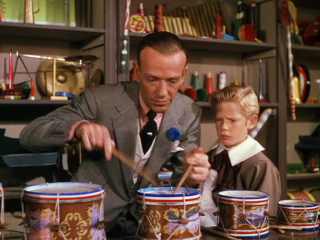
Drum Crazy. Don sees a cute stuffed bunny in a toy shop that he
wants to buy, but a young boy grabs it possessively. So Fred dances a
number in the shop to try to get the boy to settle for a drumset,
beating, kicking, and dancing on the drums in the shop. Later, an
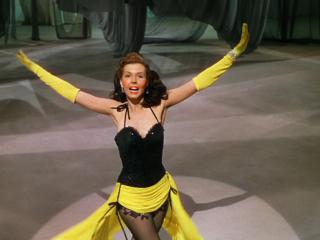
energetic Ann Miller taps her heart out in the spectacular Shaking'
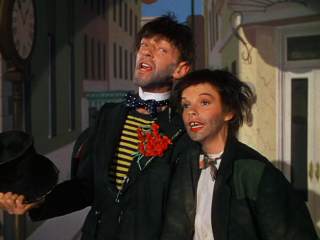
the Blues Away. A really fun number is A Couple of Swells,
where Fred and Judy play a couple of vagabonds with airs. As Gene Kelly
later pointed out in
That's Entertainment II
The film also has a lot of fun outside the musical numbers. Take the snappy dialog when Don and Hannah first meet:
Hannah: [Almost running into Don] Oh?
Don: Sorry. [Looks her up and down]
Hannah: Wh- ...?
Don: Yeah, I think you'll do.
Hannah: You think I'll do what?
Don: I'm looking for someone to dance with.
Hannah: Wrong number.
In am MGM musical, pathos is the setup for a happy ending. After Hannah and Don have had a falling-out. Johnny comes to Hannah's hotel room, finding her distraught and without makeup on after a sleepless night. When Judy is vulnerable, she is very vulnerable. Johnny's advises Hannah to take charge, and she does, sending Don a topcoat, top hat, and "what a cute bunny!" Don opens the door to find Hannah resplendent in white, self-assuredly feigning exasperation that he'd forgotten their date for the Parade. With the gender roles reversed, she remarks "Aren't you ready yet? Just like a man" and then launches into Easter Parade. ("I could write a sonnet about your Easter bonnet / And of the guy [girl] I'm taking to the Easter parade").
Several of the principals on the film were not originally scheduled to be in this film. Fred replaced Gene Kelly, who broke his ankle, and Ann Miller replaced a pregnant Cyd Charisse. Fred brings a different, more polished feel to the picture. Astaire also fits the Easter Parade tuxedo better. And if Cyd Charisse has legs and can dance, so does Ann Miller, who has a rosier face and a no-so sultry image. Fred and Judy make an entertaining couple. The two are quite well matched, for Fred is a famous dancer and a competent singer, while Judy is a spectacular singer and a competent dancer. The two of them interact very naturally, aided by what seem to be some ad-hoc interjections in the dialog.
The musical numbers are well-complemented by the meticulous camerawork. Cuts come extremely infrequently; the four Drum Crazy number has a mere six. We're practically watching the performers live, and it’s a joy to behold such consummate professionals. When Judy is stumbling around in the first Juanita/Hewes performance, she has to miss the rhythm and hits the cues exactly so that Fred can "correct" her. Fred's slow-motion dance in Stepping' Out with My Baby did feel a bit contrived, but the bluescreen work is of above average quality for the era and matte lines are fairly minimal.
The little touches also contribute greatly to the film. Jules Munchin has a hilarious turn as the chief waiter at a restaurant, who puts on a tearful performance when explaining the freshness of the onions in the house salad. Nadine's maid Ellie attends a rousing Hannah/Hewes performance and telephones a report about how awful it is, then scurries off so that she can catch the next number. When Don comes to Hannah's place for a candlelit dinner, he hurts her feelings by talking about nothing but a new number. Hannah says – twice in one outburst -- that he isn't even a human being, but just a pair of dancing shoes, and he responds nonchalantly, "You said that." In that same scene, Hannah asks a pointed question: "What color are my eyes?"
A musical about showpeople is a great excuse to insert random musical numbers, because they can fit anywhere. If the plot is similar to other musicals, or some developments are implausible (How did Fred manage to take a ring with him when he wasn't even expecting her to show up?), well, "That's Entertainment!" Enjoy the songs, the dances, the costumes, and the color. It's a perfectly delightful and happy film that’ll always be there when you need cheering up.
Technical
The Warner Brothers DVD is simply swell. In their ultra-resolution process, the original three-strip Technicolor negatives were scanned in at 4K, and then digital technology was used to clean them up and re-register the three colors to each other. The result is bright and colorful, with very little grain, and no color fringing at all. A few isolated shots look just a tad too saturated; these were probably opticals or replacement footage for damaged portions of the original negative.
Every time I watch an MGM musical from the Golden Era, I find it remarkable how well the musical numbers match up with the dialog — a result of the controlled studio environment in which they were shot. Later musicals of the 1960s and 1970s, with more location shooting, would often combine high-quality prerecorded-songs with muffled, hissy dialog. But here in 1948, the seamless interaction of dialog and music is very much enhanced by the consistently crisp audio.