Film Review: The Double Life of Veronique (1991)
La Double Vie de Véronique (1991)
aka The Double Life of Veronique
directed by Krzysztof Kieslowski
Frames in this review are taken from the Criterion Collection DVD.
France has long served as a haven for Polish expatriates. In music
there’s Frédéric Chopin, in chemistry there’s Marie Curie, and in film
there’s Krzysztof Kieslowski. Indeed, Kieslowski would pay tribute to
two centuries of Franco-Polish friendship in his
Three Colors trilogy


The Double Life of Veronique goes farther. The two people here
are connected in a far deeper way, for they are two instances of the same
young woman: Weronika in Poland, and Véronique in
France. Both are played by French actress Irène Jacob. (Duality is a
common theme in Kieslowski films: the posthumously-produced
Heaven
In Krakow, the Polish girl Weronika auditions to sing with an orchestra. Despite her lack of formal training, she performs so brilliantly at the audition that she is selected for the position. However, she is afflicted with a serious heart condition. After literally singing her heart out, she drops dead a few minutes into her first concert performance.
Hundreds of miles away in France, Véronique is at this very moment experiencing a different sort of death, la petite mort of orgasm. Afterwards, she feels a profound sensation of loneliness, as though she had just lost someone close to her. The next day, she abruptly decides to end her singing lessons, greatly disappointing her vocal tutor. In class the next day, she has her elementary-school students play the same concerto that Weronika was singing as she died, a long-lost piece by the (fictional) Dutch composer Van den Budenmeyer.
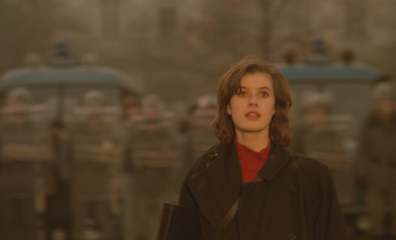 Véronique had unknowingly taken a photo of Weronika as her
tour bus was speeding away from a riot in Warsaw. After the photos are
developed, Véronique becomes aware of her doppelganger. (In typical
Kieslowski fashion, the photos are black-and-white and seen on a contact
sheet. Like Irène Jacob's fashion shoot in Three Colors: Red,
these would not be drugstore color negatives!).
Véronique had unknowingly taken a photo of Weronika as her
tour bus was speeding away from a riot in Warsaw. After the photos are
developed, Véronique becomes aware of her doppelganger. (In typical
Kieslowski fashion, the photos are black-and-white and seen on a contact
sheet. Like Irène Jacob's fashion shoot in Three Colors: Red,
these would not be drugstore color negatives!).
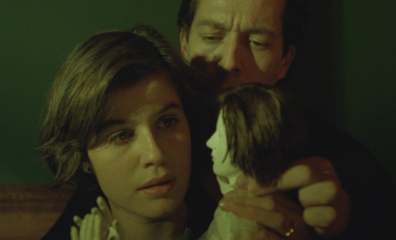
She sees a puppet show, and afterwards she is connected to the puppeteer in a roundabout way. She receives a puppet string in the mail, then a cassette tape with various background sounds whose origin she tracks to a café at a Paris train station. The puppeteer tells her of a play that he is writing about two identical girls. One of them had burned her hand on a stove, and the other one pulled her hand away at the last minute, as though forewarned. "Why two?" she asks. "They're fragile," he responds, "They break."
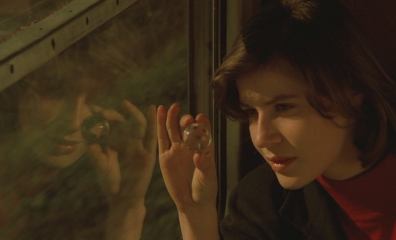
There are many parallels in the film: the little glass ball that both Veronicas play with, their kindly widower fathers, the headphones they wear to shut out the world while listening to tapes. But the connections do not exist merely at the circumstantial level. Both Veronicas have a curiosity about the natural world. As toddlers, one gazes at the stars while the other examines leaves with curiosity. Both are perceptive about their surroundings, taking simple pleasure in everyday activities like exhaling to fog up a window on a cold winter's day. Both are impulsive and quick to fall in love.
And yet, there is a key difference between the two young women. Weronika is eager and vivacious — on the phone to her friend in Krakow, as Communism is collapsing around Eastern Europe, she playfully whistles the Internationale. Véronique, on the other hand, is drifting along and searching for meaning in her life. One of her friends is in the middle of a messy divorce and is looking for ammunition to use in court; Véronique volunteers to testify falsely that she had slept with the estranged husband 17 times in the past year. When she finds the puppeteer in the café, she is distraught at the idea that he had only been toying with her, for she had expected something more.
Kieslowski is a consummate auteur, and explores similar themes in many of his films. Identity, of course; the transformative power of music; and the ironic twists of morality in interpersonal relations. What is the significance of the divorce case, or of the old woman in the street? In a Kieslowski film, they are not necessarily significant by themselves, because the film relies on the combined impact of all these ideas and images, taken just as they are. It's not like one of those overly-clever flashback-laden or non-linear American whodunits that so delight the college film crowd, where every piece has to fit into a jigsaw to produce a tableau at the end. Here, there are loose odds and ends; indeed, each viewer can put together his own connections.
Still, The Double Life of Veronique is a much harder film to grasp than the Three Colors trilogy or Heaven, all of which are more plot-heavy and accessible. In Double Life, there is great dependence on precise images to make a point — little nuances of facial expressions, the warm and moody lighting. Kieslowski is very careful about composition and editing. A very enlightening featurette on one of the Three Colors DVDs has him explaining how carefully a short shot of a sugar cube dissolving in coffee was planned. A few frames shorter and the shot would be too short; a few frames longer than it would be too long. The Double Life of Veronique is a carefully-crafted apparition upon which the viewer can impose his own framework.