Book Review: The Box
The Box
How the Shipping Container Made the World Smaller and the World Economy
Bigger
Princeton, NJ: Princeton University Press, 2006. ISBN 0-691-12324-0
The Box is a 370-page (almost a hundred of which are endnotes) history of the shipping container, the economic phenomenon that revolutionized the world of shipping and underpins today's global market. The book is not as dense as an article in the Economist, which is unfortunate. Economist articles frequently read like they were written at twice the length and then edited to add figures and sharpen the analysis to the most salient points. Levinson's book does not appear to have undergone such a distillation step, which might have transformed an already interesting and insightful book into the standard work on the subject.
The Box traces containerization from its now-mythologized beginnings with Sea-Land's Ideal-X, through the Vietnam War when it proved its worth in the logistics chain, to its maturity as the enabler of global commerce. Much of the story is told from the perspective of Sea-Land maven Malcom McLean, who conceived of the container in roughly its modern form and shepherded the concept through its infancy. Along the way, Levinson follows the ASA and ISO discussions of standardized container construction and sizes, and tracks the union negotiations and votes on container handling and compensation. He also follows politicians' plans for city waterfronts, and explains how containerization caused many traditional ports to decline and newly-built ports to take their place, with a particular focus on the Port of New York. (Later it would be renamed the Port of New York and New Jersey, as Newark and Elizabeth overtook the City proper in shipping volume).
The book treats these areas discretely, examining each like a chapter in a textbook. Due to the meticulous research that went into the book, there are many interesting insights. For example, McLean is credited with having performed the first Leveraged Buy-Out (LBO), a now-common financial maneuver that was then novel, when he used the assets of the target company to enter the shipping business without having the resources for a traditional takeover. Early on, Levinson makes a point that is perceptive precisely because it is (now) obvious: namely, that Ricardo's classic work on comparative advantage "assumed that only production costs mattered; the costs of shipping ... did not enter his analysis. Ricardo's assumption that transportation costs were zero has been incorporated into economists' models ever since, despite ample real-world evidence that transportation costs matters a great deal." (p. 13) After all, the reason that Wal-Mart carries so many global goods is that the reduction of trade barriers has begun to approach the hypothetical frictionless market of the most simplistic and heretofore unrealistic economic models.
The history also leaves the reader with an appreciation of just how much has changed since the day McLean began his container service. A list on p. 209 of 1969's largest container ports is notable not only for the absence of today's massive Asian ports (contrast to the 2003 list on p. 273), but also for the tiny volumes, almost two orders of magnitude lower than the present-day figures. True, containers did not yet possess an overwhelming share of ocean freight in 1969, but even a 10x improvement is astounding for a physical process like shipping. The ratemaking process of the Interstate Commerce Commission, which sought to maintain stability, seems almost quaint. The ICC has now been gone only for a decade, but negotiated and market-clearing rates already seem to be the natural state of affairs. Yet the ICC comes across as merely a speed bump, issuing reasonable rulings that allowed innovation so long as it did not topple the established order overnight. The New York Times editorials referenced in the book carry a familiar tone, chiding posturing politicians for standing in the way of economic sense, yet overoptimistically hailing the labor settlements as a new day forward for the City (actually, the end of the City as a major port was nigh).
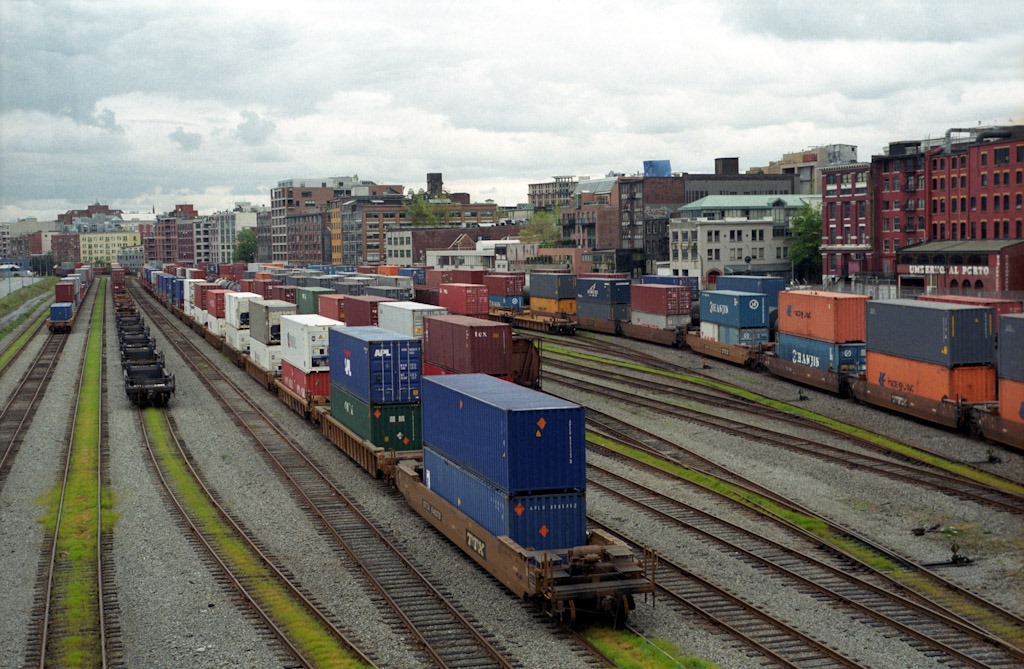
The changing face of rail freight. Containers, containers, containers. Prime waterfront property in Vancouver, British Columbia.
Unfortunately, Levinson focuses too much on each aspect of containerization's rise, never clearly tying the threads together. This book could have been the standard introduction to containers, the book that analyzed not just the origins but also the present trends in containerization. One always walks away from an Economist article with enough depth to at least carry on a dinner conversation with one of the principals. But Levinson focuses on the container's early history, so events taking place after the 1970s are rapidly passed over in compressed form. He also dangles many juicy tidbits that are left hanging. Railroads are described on p. 168 as being worried about losing revenue, without any explanation of why they weren't chasing profit instead. Indeed, intermodal transport is a hot topic, and railroads get short shrift, though the book does explore railroads' first tentative steps into trailer traffic. (But that means they are profit-driven. In any case, why wouldn't containers have the same or greater profit margin advantage than trailers?)
The thorough discussion of container standardization touches on mechanics and engineering, and provides an opportunity for a side note on the container’s conformance to the theory of path dependence. (Classic but apocryphal examples of path dependence are the QWERTY keyboard, and the urban legend about the size of space shuttle boosters being determined by the width of a horse's behind.) However, Levinson does not pick up this opportunity, instead leaving us with the puzzling situation of geometrically-sized standard containers (10 feet, 20 feet, 40 feet), which Sea-Land refuses to adopt since they do not match the company standard of 35 feet. What are the standards today, and what does Sea-Land use? Levinson doesn’t tell us.
Levinson mentions that companies were loath to containerize too quickly lest they end up with an inventory of containers in nonstandard sizes — how did this end up playing out, and who picked up market share as a result? The mechanical details might also benefit from a couple of diagrams, though one might blame Princeton University Press just as much as the author for not taking the initiative. For that matter, Levinson does not even define TEU (Twenty-foot Equivalency Unit) until the last third of the book, rather late for such an important measurement. Imagine if a book on the metric system [related book review: The Measure of All Things] did not mention the meter in the first dozen pages.
The author asserts that this is the first book devoted entirely to containers. This may very well be. It is certainly an interesting topic that deserves more study. Specifically, we need a better book on the material covered in the last quarter of The Box, which rapid-fire progresses through the most recent three decades of container shipping. This summary may be sufficient for an Economist Special Report, perhaps, but is too telescoped in a full book on containerization. We do not learn how the union saga continues to play out — what were the strikes of the late 1990s about, and how did they impact global trade? What happened to South Vietnam's container port after South Vietnam ceased to exist? Is it Vietnam’s principal container port today, or did it fall by the wayside?
The Box offers an intriguing taste of containerization, but serves more as appetizer than entree. Frustrating, perhaps, but you should eat your salad. "More, please" is hardly strong criticism of a survey book.